
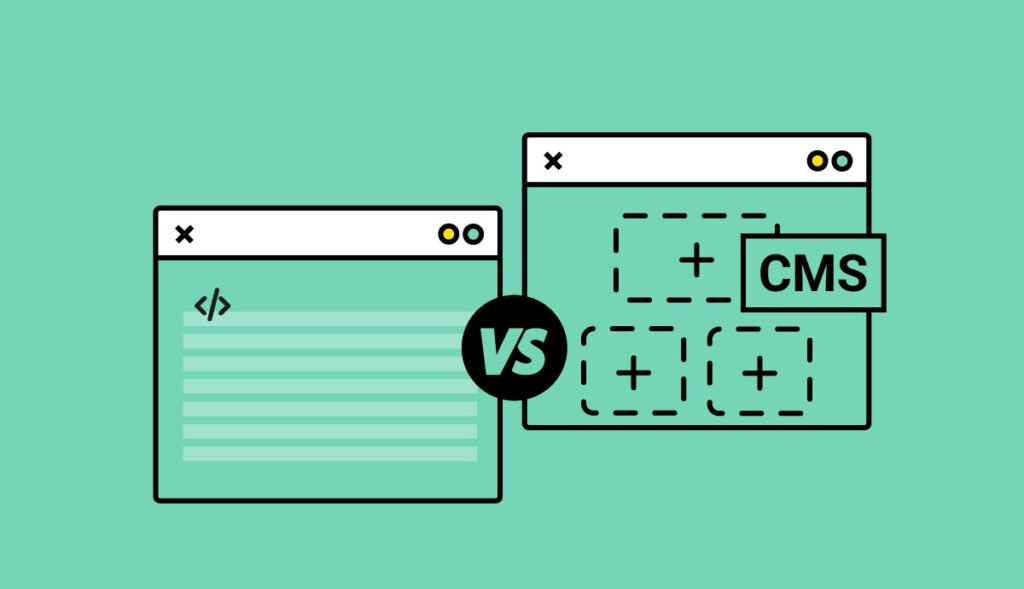
Torn between a CMS and a custom website for your business?
This choice affects your costs, performance, and data security.
Here’s a clear comparison to help you pick the right option.
What Is a CMS?
A CMS (Content Management System) lets you build and manage a website without coding. The best-known ones are WordPress, Drupal, and Joomla. It’s quick to launch, cheaper upfront, and simple to manage.
Choosing a CMS comes with several advantages: fast launch, low initial cost, a wide choice of plugins. But this approach starts showing its limits as the project grows more complex.
A CMS lets you launch a site quickly, at a lower cost, with plenty of customization options through plugins.
These extensions add functionality without requiring dedicated development.
A CMS does have certain technical limitations, but that doesn’t necessarily make it less secure than a custom-built site. Security mostly comes down to the quality of the developer’s work, regular updates, and the server being used.
For example, a well-maintained WordPress site, with official plugins and reliable hosting like Infomaniak, will often be more secure than a custom-coded site built by an inexperienced developer. Conversely, a well-designed custom site allows for deeper customization and better performance, since the entire codebase is controlled from start to finish.
A CMS runs on a shared foundation used by millions of sites worldwide. That’s what makes it quick to set up, but it also means that if a vulnerability exists in that foundation (such as in a popular plugin or theme), several sites can be affected at the same time. Fortunately, these vulnerabilities are usually patched quickly by the teams maintaining the CMS, provided the site owner actually installs the updates.
In short, the real risk doesn’t come from the tool itself, but from how it’s managed: a neglected CMS becomes vulnerable, and so does a poorly executed custom build. Security depends above all on the developer’s diligence and ongoing technical follow-up.
Among the many CMS options out there, WordPress remains the most used in the world (over 60% of the market according to W3Techs).
The Custom Website: Total Freedom
A custom website is built to meet your needs exactly, both on the visible side and the technical side.
The visible part, called the front-end, is what the user sees: the design, the text, the images, the buttons, the forms — everything displayed in the browser. It determines the user experience, how smooth navigation feels, and the site’s visual identity.
The hidden part, called the back-end, is the code that makes the site actually work. It handles the exchanges with the server: saving a form submission, displaying a product, logging a user in, processing a payment, and so on. It’s written in languages like PHP, Python, or Node.js, and it’s what makes the site dynamic and connected to a database.
Custom development, then, lets you fully control both layers — visible and invisible — to create a site that’s faster, more secure, and perfectly suited to your needs. It’s the best option if you have precise requirements and specific technical needs. Naturally, take care to document all these specifics in a project brief.
As mentioned earlier, a custom-built website is a solution 100% aligned with your criteria, but it’s also an approach that offers greater security and lets you optimize performance to the fullest. The user experience improves noticeably as a result, since the design can be fully tailored to visitors’ real needs. Thanks to UX/UI principles (user experience and interface), every element — from the menu to the page layout — is designed to ease navigation, guide attention, and encourage action.
According to a study by Kinsta, WordPress holds more than 60% of the global CMS market and powers 40% of all websites.
Swiss Specifics You Should Know
Since the new Federal Act on Data Protection (Fedlex – nFADP) came into force, Swiss companies need to be more transparent about how they use data.
For WordPress, for instance, data like passwords, emails, and form information is protected by WordPress itself, by the server (SSL), and by the hosting provider or certain plugins as well.
For a site built with pure code, security is handled by the developer through various measures. This includes the SSL mentioned above, which is a server-level function, along with methods for securing data, passwords, and defending against attack attempts, code errors, and inconsistencies — plus plenty of other techniques you can find in this secure coding guide.
If you handle sensitive data, opt for local hosting. At Mondi Agency, we recommend Infomaniak.
CMS or Custom: What Should You Choose Based on Your Situation?
| Type of Business | Recommended Solution | Main Reasons |
|---|---|---|
| Small SME, blog, showcase site | CMS (WordPress) | Fast, cost-effective, easy to manage |
| Mid-sized business | Advanced or hybrid CMS (Headless) | A balance of flexibility and cost, with better SEO performance |
| Sophisticated e-commerce (500+ products) | Custom | More stable, better optimized |
| Sensitive data | Custom, hosted in Switzerland | Compliance with the nFADP law |
CMS platforms can also suit complex projects, provided there’s solid technical configuration and high-performance hosting.
A Third Alternative: Headless CMS
Headless CMS sits between a classic CMS and custom development.
It keeps the simplicity of managing content through a CMS without touching code, while offering the flexibility of a hand-built site.
A Headless CMS keeps the ease of management of a classic CMS while allowing for 100% custom rendering using modern technologies (React, Next.js, and so on).
Content and presentation are decoupled: the CMS is used solely to manage the data, while an external interface (front-end) displays it.
This makes it possible to build sites that are fast, scalable, and connected across multiple channels (web, mobile, apps).
That said, setting it up requires more technical skill than a traditional CMS and can cost a bit more upfront.
For brands looking to combine creative freedom with performance, Headless CMS often offers the best compromise.
SEO and Performance
A site built with a CMS like WordPress can absolutely rank well on Google, provided it’s well built and regularly optimized. That means clear content, fast-loading pages, and a logical structure Google can easily understand.
A custom site, on the other hand, can go even further, since the code is entirely tailored to the project’s needs. But in both cases, SEO mainly depends on the work done by the person building and maintaining the site — not just the technology used.
By the way, if you’re looking for a Swiss SEO expert to talk through your business and its positioning on Google, feel free to reach out to us.
If you’re working with a developer to code your site, it’s important to understand how pages can be rendered. There are three main methods:
SSR (Server Side Rendering) The server prepares the complete page before sending it to the visitor. The content displays right away. This is the most common method for showcase sites, blogs, or online stores, since it’s fast and well understood by Google.
CSR (Client Side Rendering) The browser receives a nearly empty page, then loads the content using JavaScript. This takes a bit more time, but it allows for interactive elements without reloading the page, like a dashboard or a dynamic user interface.
SSG (Static Site Generation) Here, pages are prepared in advance, at the time the site is deployed. When a visitor arrives, the page is already ready: it displays instantly. This is the fastest method for stable content (articles, product pages, FAQs).
In most cases, SSR is the better choice, since it offers a good balance between speed, SEO, and content updates. CSR remains relevant for highly interactive sites, and SSG is ideal when content doesn’t change often.
Mondi Agency Can Support You
Need help choosing between a CMS, a custom website, or a Headless CMS? Mondi Agency helps Swiss companies build high-performing sites tailored to their needs.
Custom and WordPress website creation Discover our agency View our portfolio Request a free quote
Conclusion
The right choice depends on your priorities.
A CMS is ideal for a quick launch and a limited budget. A custom site becomes the right call if your needs are specific or sensitive. Headless CMS is often the right balance for brands looking to combine creative freedom with performance.
And if you’d like a website that meets both your requirements and Swiss regulations, Mondi Agency can support you every step of the way.