Why Does This Choice Matter So Much for Your Business?
In 2024, the Swiss advertising market generated CHF 6.12 billion, of which CHF 2.1 billion (34.3%) came from digital advertising. Of that spend, 66% went to search engine advertising, mainly through Google Ads, while Social Ads accounted for a significant share of the rest (PwC Suisse).
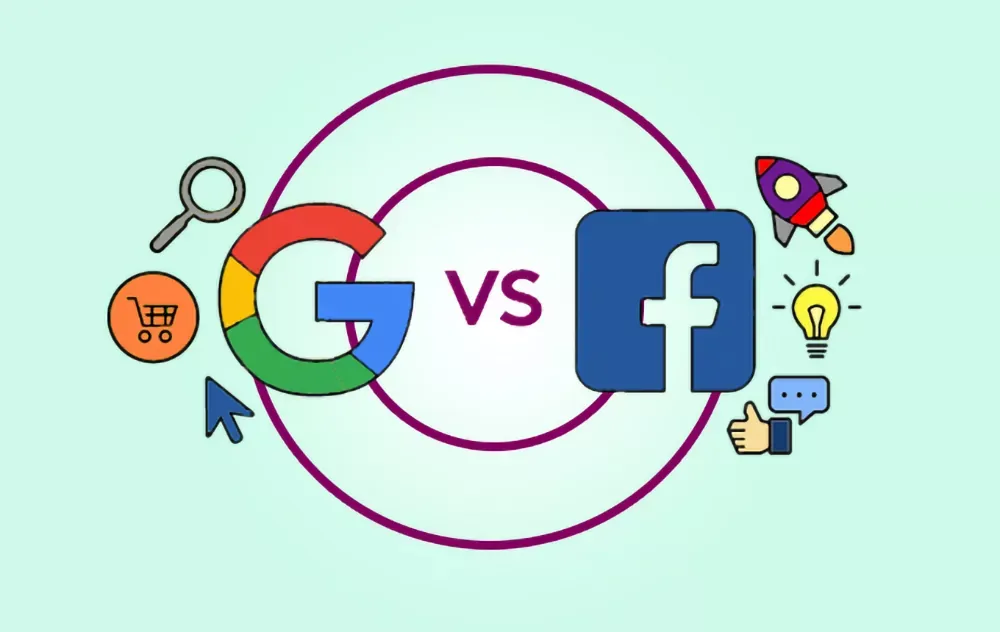
Given this split, it’s essential for Swiss businesses to understand the differences between Google Ads and Social Ads in order to optimize their advertising strategy and their return on investment. The stakes are wide-ranging: attracting qualified prospects, building brand awareness, generating sales, and improving customer retention.
Google Ads: Capturing Purchase Intent
Google Ads lets you show targeted ads to users running specific searches. This approach is particularly effective for reaching people with a clear intent to buy.
Purchase intent here refers to a customer’s readiness to buy a product or service within a more or less near future. The journey from intent to purchase breaks down into 4 stages.
Stage 1: Becoming Aware of the Need
Awareness happens when a customer recognizes they need to make a purchase. Say their bed no longer suits them — the customer becomes aware they need to buy something, but they aren’t ready yet to turn that need into intent, since confirming the need and doing some preliminary research still has to happen.
Stage 2: Interest and Research
The second stage is information gathering. The customer starts collecting information across different channels, whether that’s specialized furniture or bedding websites, to continue with the earlier example.
There’s also visiting stores directly, and asking friends and family for advice.
Purchase intent isn’t 100% established yet at this point. Because often, despite all the information gathered, the choice of store or brand still hasn’t been made.
Stage 3: Desire
Once the customer has enough information to make a decision, they now weigh up the different products available to them. Their purchase intent is reinforced — the only question left is where they’ll buy.
Stage 4: Action
At the end of the journey, the customer buys the product and uses it.
But there can sometimes be a gap between what a customer plans to do and what they actually do — for instance, they might decide to buy a bed and then change their mind once they’re in the store.
That’s why it’s important to gather as much information as possible about someone’s purchase intent — for example, the amount they’re planning to spend. This helps you respond better to the customer’s needs.
Purchase intent, then, isn’t as simple as it looks, because a customer’s intent can shift at different points along the buying journey.
To best meet their needs, it’s important to identify which stage they’re at in their journey, so you can better target their wants and gauge how solid their intent really is.
Social Media Ads: Paid Advertising on Social Networks
Facebook Ads
To build brand awareness and reach a precise audience, Facebook Ads remains essential. Facebook is the most used social network in the world, with around 40 million monthly active users in Europe. Ad formats are varied, letting you choose the ones that best match your targets and objectives: awareness, engagement, or conversion.
Facebook Ads doesn’t just strengthen your online reputation — it also encourages users to move from casual visitor to lead or qualified lead on your site, via a contact form, an event sign-up, or a purchase. Targeting is based on precise criteria: age, gender, location, interests, behaviors.
That said, this distribution stays limited to Facebook, whereas Google Ads reaches the entire base of search engine users and partner sites.
Instagram Ads
Instagram uses the same tool as Facebook (since both belong to Meta): Business Manager. Ad strategy on Instagram relies on visuals and branding. Campaigns work best when they showcase the most impactful photos and videos, consistent with the brand image. The whole thing becomes highly codified and specific to the platform.
Stories and the news feed make it possible to build awareness campaigns. 70% of Instagram users are under 35 (Meltwater). Where Google Ads responds to existing demand, Instagram builds product awareness and sparks interest among new prospects. The two platforms complement each other, delivering either a new visitor, a qualified lead, or a customer already informed about and familiar with the brand.
LinkedIn Ads
LinkedIn is a professional network geared toward B2B. For companies targeting individual consumers (B2C), this network isn’t the best fit. But for reaching professionals, LinkedIn Ads combined with Google Ads can be highly effective.
B2B targeting is precise and works through different levers: job function, company size, skills, education level, industry. LinkedIn is mainly used to strengthen professional reputation and generate inbound leads (event sign-ups, qualified contacts). These contacts are valuable and can turn into long-term customers (DataReportal).
TikTok Ads
TikTok is the most popular network among Gen Z. Ads there are mainly aimed at awareness, engagement, and visibility. Campaigns use hashtags, challenges, or appear in the feed to build a connection with the community.
Unlike Google Ads, TikTok doesn’t directly aim to boost sales, but rather focuses on branding and retention. The mass visibility TikTok delivers is unprecedented, which is why it’s essential to work with an agency like Mondi Agency that knows how to get the most out of the platform — understanding the algorithm, and so on.
Key Differences Between Google Ads and Social Media Ads
Purchase Intent
Google Ads responds to immediate purchase intent. The user types in a specific need (“red high heels,” “house valuation”), and your ads show up at the right moment, generating qualified traffic with strong conversion potential. But showing up at the right time and at the top of the list is only possible with solid SEO and SEA work behind it.
Social Media Ads work the other way around: the user decides to convert after seeing the ad. The choice between the two strategies therefore depends on your conversion funnel and your marketing goals (nurturing existing demand versus creating new demand) — but in every case, both can be run at the same time.
Targeting
Each platform has its own specific criteria: LinkedIn for B2B, TikTok for younger audiences, Facebook and Instagram for socio-demographic and behavioral targeting. Google Ads, on the other hand, is based on search behavior and intent rather than demographic traits or age — targeting your campaign around search and intent delivers very precise targeting for effective conversion.
How It Works and the Interface
Google Ads allows for advanced precision in format selection, optimization, and budget management. Social platforms are more accessible, but less flexible. The statistics differ too: impressions, interactions, clicks, or conversions, depending on the tool.
Having all these KPIs makes it possible to target and evaluate, with great precision, the impact, profitability, and usefulness of your campaign.
Budget Management
Google Ads offers several bidding systems suited to each type of campaign. Social networks bill based on the format selected. Budget stays under control either way. Optimizing that budget is essential to maximizing campaign effectiveness.
Working with a specialized agency like Mondi Agency makes it possible to run ads in a profitable and smart way.
Complementarity Between Google Ads and Social Media Ads
These two approaches aren’t mutually exclusive. Google Ads lets you capture prospects at the exact moment they have a need, while social ads help build awareness of a product or service and spark interest. Using both in parallel creates a synergistic effect: you generate both brand awareness and qualified conversions at the same time (ONAUDIENCE).
Why Work with a Specialized Agency?
Mondi Agency can define, for and with you, the best strategy for your business, combining Google Ads and Social Ads according to your goals. An agency’s expertise makes it possible to optimize your campaigns, precisely target your audiences, and maximize return on investment.
The choice between Google Ads and Social Media Ads depends on your company’s goals, your audience, and your budget. The two solutions are complementary: Google Ads responds to existing demand, while Social Media Ads help create demand and build brand awareness. For optimal impact, an integrated strategy supported by a specialized agency is strongly recommended.