
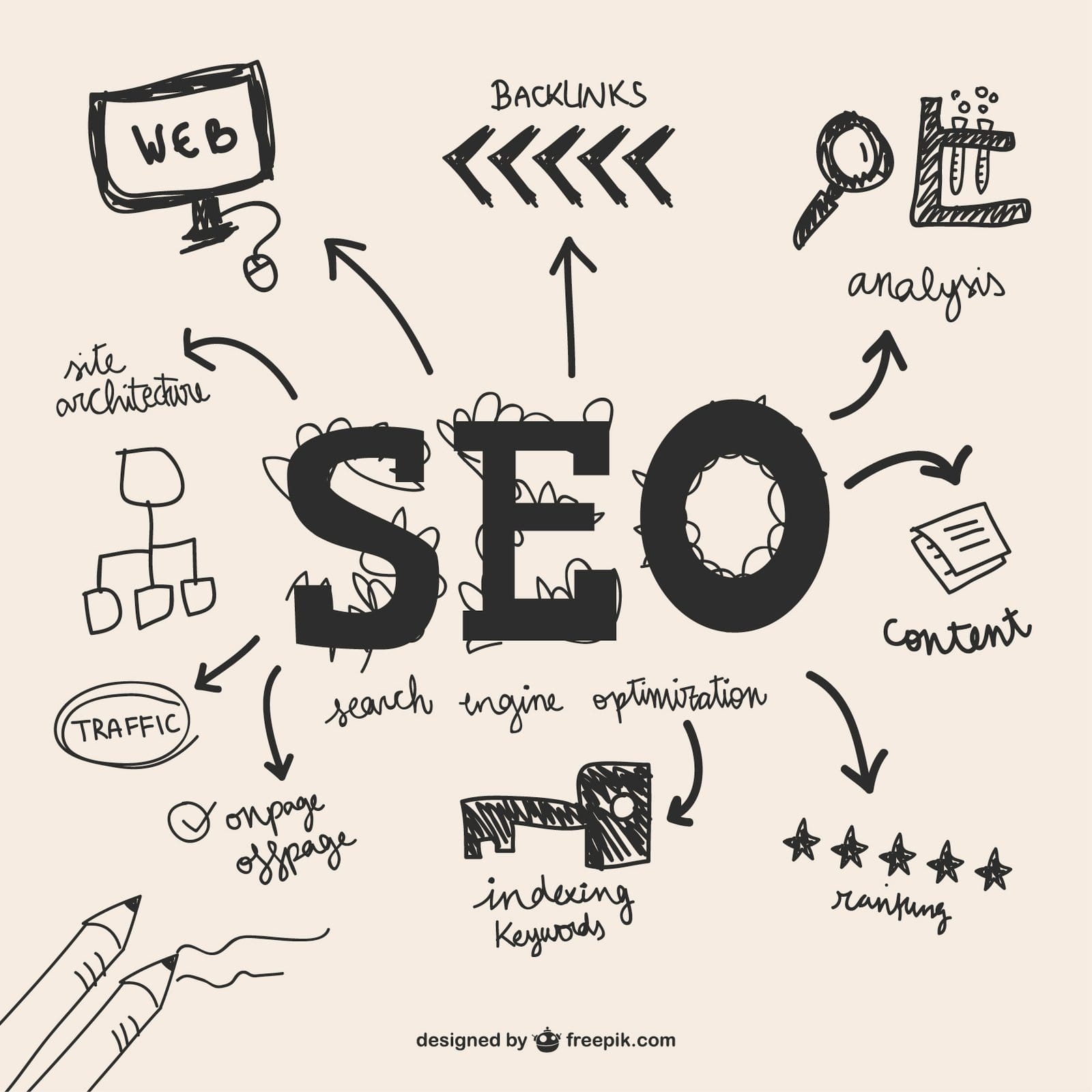
Introduction: The 2025 SEO guide for Swiss SMEs
Organic search is no longer optional — it is an essential lever for attracting clients and growing your business. With the accelerated digital transition of recent years, online competition is fiercer than ever. In Switzerland as elsewhere, thousands of businesses are investing in digital, making SEO indispensable if you want to stand out.
Competition is therefore getting tougher, and the search engines (Google, Bing…) keep refining their algorithms. What worked yesterday is no longer enough today. If your site does not keep up with these changes, it risks losing visibility, traffic… and inevitably revenue.
But don’t panic. Whether you are an entrepreneur, self-employed or running a company, this guide will give you concrete, actionable keys to improve your ranking on the search engines (SERP). No obscure strategies here, and only a little marketing jargon (which we explain along the way). We get straight to the point: how to climb to the top of Google’s results and attract qualified traffic.
Understanding the specifics of digital in Switzerland: a key asset for your SEO
Before optimising your SEO, it is essential to understand the particularities of the Swiss digital market. Why? Because every country has its own search behaviours and consumer expectations. Aligning with these local dynamics means maximising your visibility and attracting more qualified traffic.
In Switzerland, several factors directly influence the performance of your organic search. Here are the key points to know so you can adapt your SEO strategy effectively.
An unavoidable linguistic diversity
If you are an international marketer, don’t forget: Switzerland is a multilingual country with four official languages. You therefore need to adapt your content to each region.
Language distribution in Switzerland
- German: The majority (Zurich, Bern, Basel).
- French: Essential for French-speaking Switzerland (Geneva, Vaud, Fribourg).
- Italian: Indispensable in Ticino.
- Romansh: A niche, but not to be ignored depending on your audience.
If someone on your team speaks Swiss German, the local dialect, you can use it in your ads, article titles or in certain passages on a page. This creates a stronger sense of closeness than using standard German. A gesture your readers will notice and appreciate.
NB: A growing share of younger generations and professionals run their searches in English. If you target a young or international audience, offering content in English can be a real acquisition lever.

languages in Switzerland. source: Wikipedia
Mobile usage in Switzerland
Switzerland has one of the best-performing Internet networks in Europe, with high-quality mobile coverage. In 2023, 98% of Swiss households had Internet access, and 96% of the population mainly used smartphones to get online (source: vd.ch).
This trend underlines the crucial importance of optimising your site for mobile users. A responsive, lightweight site is no longer a mere option but a necessity to stay competitive. All your competitors are aware of it, so do not neglect this aspect.
Core Web Vitals play a key role in your SEO ranking. These indicators, introduced by Google, assess the user experience by focusing on three aspects:
- Loading speed (Largest Contentful Paint – LCP): The time needed to load the main content of the page.
- Interactivity (First Input Delay – FID): The delay between the user’s first interaction and the site’s response.
- Visual stability (Cumulative Layout Shift – CLS): The measure of unexpected shifts of page elements during loading.
A slow site, or one poorly optimised for mobile, can drive your visitors away before they even discover your content.
It is commonly said that if a site takes more than 3 seconds to load, more than half of users abandon their visit.
Trust and quality above all
Swiss consumers are known for their high standards of precision, quality and reliability. To build a relationship of trust and optimise your SEO, it is essential to:
- Secure your site with HTTPS: Adopting the HTTPS protocol ensures the encryption of data exchanged between the user and your site, guaranteeing the confidentiality and integrity of information. An unsecured site can put visitors off and negatively affect your position on the search engines. Google considers HTTPS a ranking factor, favouring secure sites in its search results.
- Comply with data protection legislation: Switzerland has updated its Federal Act on Data Protection (FADP), in force since 1 September 2023, to align with the European Union’s General Data Protection Regulation (GDPR). It is imperative to display a clear, transparent privacy policy detailing the collection, use and retention of personal data. This reassures your users and demonstrates your commitment to protecting their privacy.
- Use trust badges: Displaying recognised certifications, security seals and authentic customer reviews strengthens your brand’s credibility. Positive testimonials and favourable ratings influence purchase decisions and improve your online reputation. Trust badges will improve your conversion rate, which indirectly has an impact on your SEO (and your revenue)
Note: An unsecured site (without HTTPS) will in 99% of cases lead to a significant drop in traffic, as users are increasingly aware of online security issues. It is therefore crucial to obtain an HTTPS certificate to protect your visitors and improve your SEO.
Local SEO: the Swiss directories to consider
To improve your local search visibility in Switzerland, it is essential to be present on relevant online directories. While some traditional platforms may have lost popularity, others remain essential:
- local.ch: This platform remains a reference for local visibility in Switzerland, offering a large database of businesses and services.
- search.ch: An archive the Swiss used in the early 2000s-2010s — you can still list yourself there, as this URL continues to record more than 1.7 million monthly searches according to ahref
Beyond these directories, it is crucial to keep your profile up to date on Google Business Profile (formerly Google My Business). Make sure your information (address, opening hours, contacts) is accurate and encourage your satisfied clients to leave positive reviews. This will improve your ranking in local searches and encourage potential clients to choose your business.
Depending on your sector, other specialised directories may also be relevant. For example, for restaurants, platforms such as TripAdvisor or Yelp can be beneficial. It is important to choose quality directories matching your field rather than multiplying pointless listings.
Finally, don’t forget that local SEO is not limited to directories or Google.
An active presence on social media, taking part in local events and earning backlinks from local sites can also strengthen your visibility.
NB: Social networks are increasingly used as search engines. It is therefore important to optimise your local SEO on these platforms too.
The Fundamentals of SEO
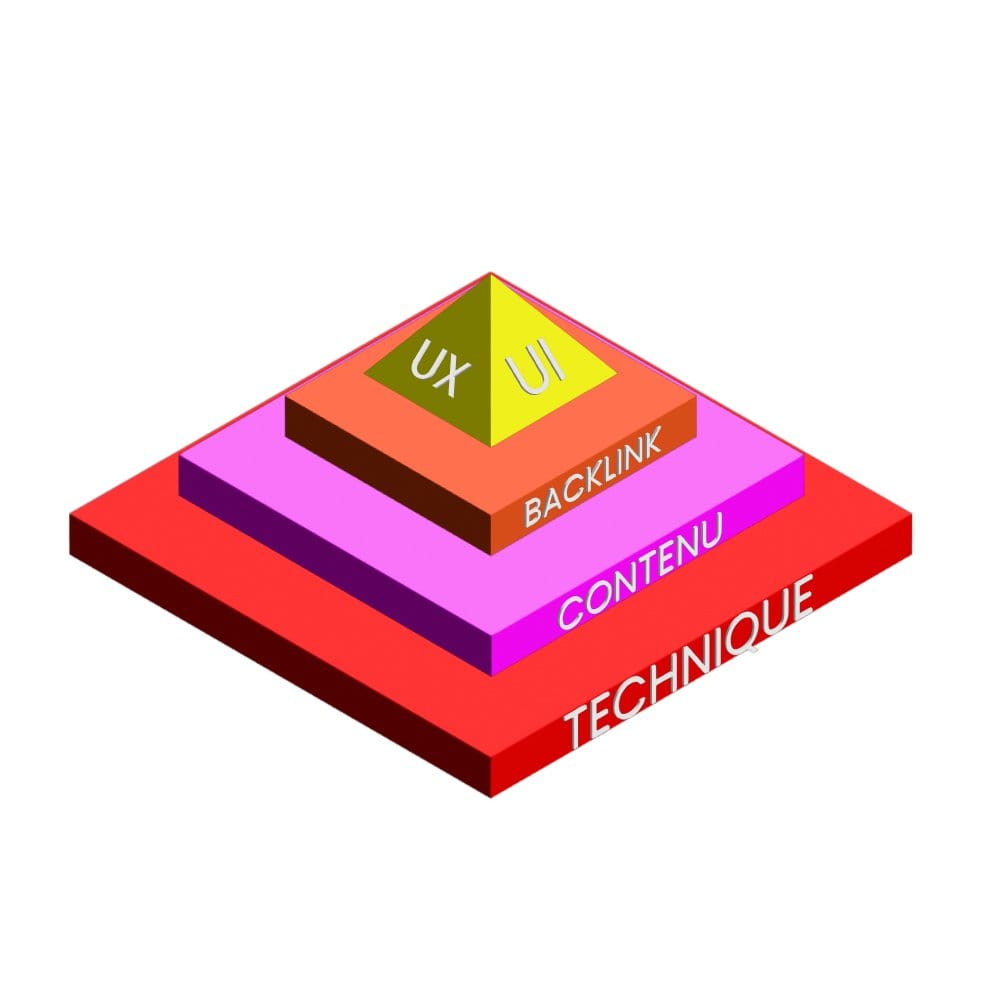
Schematic pyramid of the fundamental building blocks of SEO
Domain authority and backlinks
Domain Authority (DA) is a metric developed by Moz to assess a site’s credibility and its ability to rank in search engine results. Although DA is not a direct ranking factor for Google, it remains a valuable indicator of backlink quality and a site’s overall authority.
Why should backlinks be part of your strategy?
Backlinks, or inbound links, are hyperlinks from other websites pointing to yours. Google treats them as “votes of confidence”: the more quality, relevant links you receive, the more credibility your site gains and the better its chances of ranking well. For example, a link from a site recognised in your sector immediately strengthens your reputation.
Quality vs. Quantity
It is essential to favour natural, quality backlinks from relevant sites, influential media or experts in your sector. Dubious link-building techniques remain very risky. For example, an offer of a large number of cheap backlinks may hide low-quality links or links from irrelevant sites, which can harm your rankings. It is therefore crucial to focus on quality rather than quantity.
Paid partnerships to gain domain authority?
Google penalises artificial link buying / toxic links. If you want to set up a partnership with a blogger and pay them in exchange for a link, they will in theory, if they follow Google’s rules, be obliged to set the link’s rel attribute to sponsored: rel="sponsored" or rel="noopener", which does not pass SEO authority the way a rel="dofollow" link does. It is therefore preferable to favour natural, unpaid partnerships to benefit fully from the authority passed by backlinks.
That said, a paid article is not necessarily bad practice. Google is aware that link buying is part of the web market and will not systematically penalise a sponsored link in a reputable outlet such as Forbes.
On the contrary, such an article can strengthen your credibility and establish your authority far more effectively than a thousand toxic backlinks bought for €50 on a dubious site.
Case study: the impact of poor-quality backlinks
One site we analysed temporarily reached first position thanks to a large number of dofollow backlinks. A detailed analysis revealed that the majority of these links came from irrelevant sites, often hidden at the bottom of the page (prefooter). The result: a brutal drop in the rankings a few months later. This illustrates how much backlink quality matters over the long term.
How to earn quality backlinks?
- Get mentions in the Swiss media: Being cited in recognised publications such as Le Temps, Tages-Anzeiger or Neue Zürcher Zeitung can considerably strengthen your authority. To achieve this, pitch relevant press releases or guest articles. (more info: services-entrepreneurs.ch)
- Build partnerships with local businesses: Working with local businesses, your town hall, or listing yourself in professional directories and Swiss chambers of commerce can help you earn relevant backlinks and strengthen your local presence. (more info: chocoweb.ch)
- Regularly monitor your backlink profile and your competitors’: Use tools such as Ahrefs, Moz or SEMrush to analyse the links pointing to your site and to your competitors’. You can then contact the websites talking about your competitors and suggest they mention your business too. (more info: seoquantum.com)
Keyword research and search intent
Understanding users’ search intent is essential for building an effective SEO strategy. When selecting keywords, it is crucial to consider the user’s underlying goal:
- Informational queries: The user is looking for information or answers to a question.
- Example: “How to set up an SME in Zurich?”
- Navigational queries: The user wants to reach a specific site or page.
- Example: “UBS bank login”
- Transactional queries: The user is ready to make a purchase or take a specific action.
- Example: “SME accounting service Geneva”
Long-tail keywords are phrases of four words or more. Although they generally generate less traffic, they have a higher conversion rate because of their specificity.
- Example: Rather than targeting “vegan restaurants”, go for “best vegan restaurants in Lausanne”.
Using Google Search Console
Google Search Console is a free tool provided by Google that offers valuable insights into your site’s performance in the search results. Among other things, it lets you identify the queries driving traffic to your site and analyse impressions, clicks and the average position of your pages. This data is essential for refining your keyword strategy and understanding your audience’s search intent.
Other Google tools to use
- Google Keyword Planner: Originally designed for advertisers, this tool is also valuable for SEO. It helps identify keywords relevant to your business, provides search volume estimates and suggests related keywords.
- Google Trends: This tool lets you track how keyword popularity evolves over time and by region. In Switzerland, where several languages coexist, Google Trends is particularly useful for adapting your content to local and linguistic trends.
Harnessing artificial intelligence to refine your SEO strategy
To stay competitive on strategic keywords, you will need to use platforms like SEMrush and Ahrefs which integrate artificial intelligence to analyse keyword variants, search intent and semantic relevance. These tools offer in-depth analyses to optimise your content according to user expectations and market trends.
Studying competitors’ keywords
With these same tools (SEMrush, Ahrefs, …) you can analyse the keywords your competitors use, assess their performance and identify opportunities to exploit. This competitive analysis helps you discover relevant keywords you would not have considered and adjust your strategy accordingly.
A practice in vogue at the end of 2024 was to go on Reddit, collect the most frequently asked questions on a given topic — for example those with the most Upvotes. Then prompt ChatGPT with
Generate 20 SEO article ideas for my ____ business based on the questions I'm going to give you... Monitoring emerging SEO trends
Artificial intelligence is changing how content is ranked and displayed in the search engines. It is therefore indispensable to stay informed about SEO developments, such as Google algorithm updates, new practices around voice search or changes in user behaviour. Adapting to these developments will let you maintain and improve your position in the search results.
Crawlability and indexing
Good rankings rest on effective indexing. If the search engines cannot properly crawl and index your content, it will remain invisible to users.
Key elements to improve crawlability:
Robots.txt file
- Tells the search engines which pages to crawl and which to ignore.
- Check that no essential page is blocked by mistake.
- Tools like Screaming Frog let you quickly analyse potential errors.
XML sitemap
- Lists the important pages to make them easier to index.
- Submit it to Google Search Console and Bing Webmaster Tools.
- Make sure it is kept permanently up to date.
NB: For Bing, the indexing algorithm does not tolerate external HTTP requests. If you cannot work out why Bing Webmaster refuses to index your pages, use the Dev Tool and search for http://. If you find a request in a script, I advise you to change it. That should normally unblock your indexing. (This kind of error usually comes from a third-party factor, such as a plugin or similar.)
Canonical tags
- Help avoid duplicate content problems by indicating the main version of a page.
Recommended actions for optimal indexing:
- Check indexing status with Google Search Console.
- Use tools like Ahrefs Site Audit to identify technical errors.
- Optimise site structure and internal linking.

From Google Search Console, you can manually index each of your pages.
If you use WordPress as your CMS (Content Management System), we advise you to use the YoastSEO or RankMath plugins, both freemium, which will let you create these files automatically without technical knowledge.
Cookie management in Google Analytics and GDPR compliance:
Although Switzerland is not part of the European Union, it has aligned its legislation with the GDPR through the new FADP, in force since September 2023. Data protection requirements are therefore similar, particularly regarding the collection and processing of personal data via cookies.
User consent
From 31 July 2024, if you use Google’s advertising products, you will need to obtain the explicit consent of Swiss users for the use of cookies and the processing of their personal data.
To ensure compliance:
- Consent banner: Implement a cookie consent banner that clearly informs users about the types of cookies used and their purpose. Users must be able to accept or refuse these cookies.
- Preference management: Allow users to change their cookie preferences at any time.
Data anonymisation
Google Analytics 4 (GA4) anonymises the IP addresses of EU users by default, which contributes to GDPR compliance. However, it is recommended to check that this feature is enabled and to use it for Swiss users too.
Alternatives to Google Analytics
Given the compliance concerns, you could consider alternatives to Google Analytics that offer similar features while being more respectful of user privacy. For example, solutions like Simple Analytics focus on protecting user data and may be more compliant with European and Swiss regulations.
Obtaining user consent:
- Before placing analytics cookies, it is imperative to obtain users’ explicit consent.
- Use a consent management platform (CMP) to display a cookie banner informing visitors and requesting their agreement. (CookieYes for WordPress, for example).
Using Google’s Consent Mode:
- Consent Mode adjusts the behaviour of Google tags according to users’ consent status, allowing partial measurement even without cookie consent.
Pillar content (Pillar Content)
Pillar content is a long, detailed article that covers a topic exhaustively. It serves as a reference and forms a central point that more specific pieces of content link back to.
Why create pillar content?
- It provides a complete, structured answer to readers’ needs.
- It attracts quality backlinks, strengthening your authority.
- It improves the organisation of your site and the hierarchy of information.
How to create effective pillar content?
- Choose a central topic relevant to your audience.
- Rely on trustworthy sources (studies, expert quotes).
- Add internal links to complementary articles.
Example: Pillar content for a lawyer
A detailed guide on “Contract law in Switzerland in 2025” could include:
- The different types of contracts (employment, sale, services).
- The legal requirements (written vs oral contracts).
- Common mistakes and how to avoid them.
- Links to in-depth articles on related topics (mediation clauses, termination, force majeure).
In short, the fundamentals of SEO rest on quality backlinks, strategic keyword research and sound technical indexing. Producing structured, relevant content improves your visibility for the long term. Nothing too complex so far.
By the way, if you would like us to take care of your SEO, it’s this way
On-Page SEO: Optimising for a better ranking
On-page SEO optimisation is essential to improve your site’s visibility on the search engines while guaranteeing an optimal user experience. Every element of your page must be designed both to meet users’ expectations and to be easily understood by Google.
Content quality and E-E-A-T or double E-A-T
In 2023, Google tightened its content quality criteria with E-E-A-T:
- Experience: Share personal experiences and concrete cases.
Example: If you write an article on “Setting up an SME in Switzerland”, add testimonials and case studies. - Expertise: Offer precise, well-documented information.
Example: For an article on “Digital marketing trends in Switzerland”, use recent statistics and expert opinions. - Authoritativeness: Showcase your experience and certifications.
Mention your qualifications, awards or notable collaborations to strengthen your credibility. - Trustworthiness: Ensure your site’s security and transparency.
Use HTTPS and display a clear privacy policy.
Practical tips
- Publish original studies (surveys, data analyses) to add value.
- Cite official sources, such as the Federal Statistical Office (FSO).
- Add author biographies to lend credibility to your articles.
Optimising tags and titles
Meta tags and titles are essential for improving rankings and visitor engagement.
Title tags (SEO titles)
- Between 50 and 60 characters.
- Include relevant keywords and, if possible, a location.
Example: “SEO Agency in Geneva – Digital Experts”.
Meta Descriptions
- Between 150 and 160 characters.
- Write an engaging description to encourage the click.
Titles and meta descriptions matter, but Google may sometimes rewrite them for specific reasons. In general, these changes will not be to your detriment.
Heading structure (H1, H2, H3…)
- A single H1 per page: It is recommended to use a single H1 per page to define the main title of the content. Although HTML allows several H1s using distinct sections, for SEO and clarity reasons it is preferable to stick to a single H1 per page.
- Using H2s and H3s: H2 tags introduce main sub-sections, while H3s are used for sub-parts within those sections. This hierarchy makes reading easier and helps the search engines understand your page’s structure.
Alt tags for images
Alt tags (alt attributes) are essential for improving your site’s accessibility and optimising image rankings. They provide a text description useful to screen readers and the search engines.
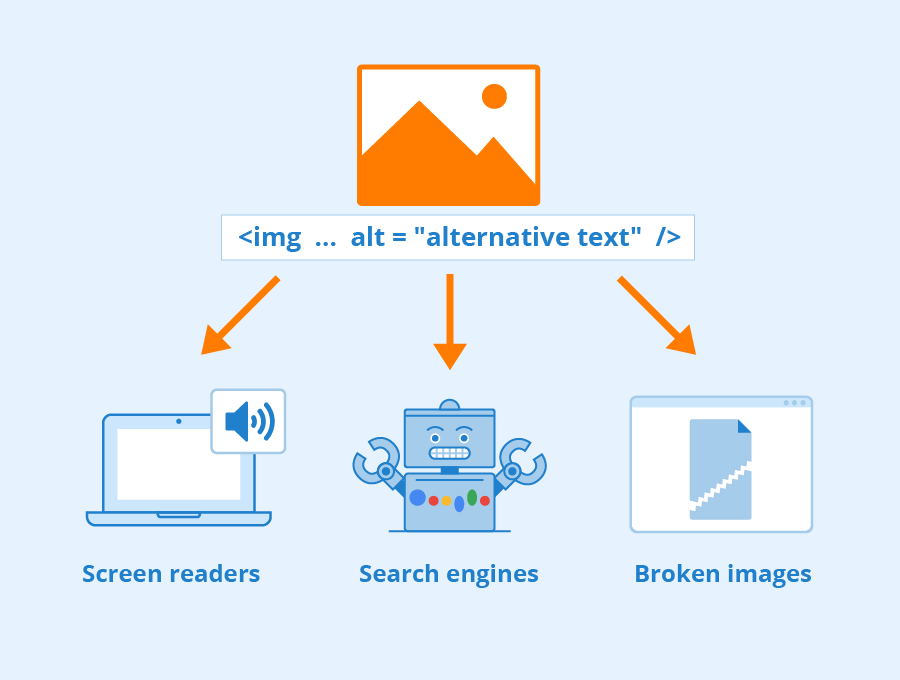
Good practices for writing effective alt tags:
- Be precise and concise: Describe the image in a few words.
Example: Instead of “dog”, prefer “black Labrador playing in a park”. - Include relevant keywords but avoid keyword stuffing.
- Avoid superfluous details such as “image of” or “photo of”.
- Leave the alt tag empty for decorative images (
alt=""). - Describe buttons and logos according to their function.
URL structure and internal links
URL optimisation
- Favour short, explicit URLs.
Example:example.ch/services-comptabilite/instead ofexample.ch/p=1234/.
Breadcrumb navigation
Breadcrumbs help users find their way around and contribute to rankings.
Good practices:
- Place them at the top of the page.
- Make sure they reflect the site’s hierarchical structure.
- Use simple separators such as “>” for better readability.
- Make every element clickable, except the last one.
Internal links
Internal links make navigation easier and help your pages rank better.
Good practices:
- Use descriptive anchors instead of “click here”.
- Ensure the relevance of internal links.
- Avoid stuffing pointless links.
- Encourage smooth navigation by maintaining a clear structure.
- Update your internal linking regularly to avoid broken links.
Loading speed and Core Web Vitals
Google takes loading speed into account for SEO ranking.
Three key criteria:
- Largest Contentful Paint (LCP): Main content displayed in under 2.5 seconds.
- First Input Delay (FID): Responsiveness to user interactions in under 100 ms.
- Cumulative Layout Shift (CLS): Visual stability with a score below 0.1.
Recommended actions:
- Use a CDN (Content Delivery Network).
- Compress images to WebP or AVIF.
- Reduce render-blocking JavaScript.
Structured data and Rich Snippets
Schema.org structured data lets Google better understand your content and display rich results.
Common types of Schema markup:
- LocalBusiness: Displays the address and customer reviews.
- FAQ Schema: Lets questions and answers appear directly in the search results.
- Products: Displays price, availability and reviews.
Recommended tools:
- Google Search Console to monitor the indexing of structured data.
- Google’s Rich Results Test.
Additional technical optimisations
Minifying CSS, JS and HTML code
Why?
- Smaller file sizes, speeding up loading.
- Improved user experience.
How to do it?
- Use tools such as Webpack, Gulp or WP Rocket.
- Enable caching via Varnish or Cloudflare.
Lazy Loading (deferred image display)
- Loads only the visible images as the user scrolls.
So to succeed at your on-page SEO, here is what we advise:
- Apply the E-E-A-T model to strengthen the expertise and trustworthiness of your content.
- Optimise the Title and Meta tags, as well as the H1-H3 structure.
- Structure your URLs and internal links for smoother navigation.
- Improve loading speed and respect the Core Web Vitals.
- Add structured data (Schema.org) to enrich your search results.
- Optimise your CSS/JS code, enable caching and apply HTTPS.
Off-Page SEO: Strengthening Your Site’s Authority and Visibility
Off-page SEO covers all the actions carried out outside your site to improve its authority and visibility on the search engines. By building a solid online presence, you can improve your ranking and attract a wider audience.
Link Building and Netlinking Strategies
Acquiring quality backlinks remains one of the pillars of off-page SEO. These external links are recommendations that signal to the search engines that your content is relevant and trustworthy.
Why are backlinks essential?
- They improve your site’s credibility in Google’s eyes
- They generate qualified traffic from partner sites
- They strengthen your domain’s authority on specific topics
Prioritise quality backlinks
- Earn links from trustworthy Swiss domains: local media (Le Temps, 24Heures, Neue Zürcher Zeitung), business news sites and specialised portals
- Avoid toxic backlinks from irrelevant or spammy sites, which could penalise your rankings
Outreach campaigns (Outreach SEO)
- Contact partner sites, influencers or experts in your sector
- Personalise your messages by highlighting the mutual benefits of a link exchange
- Offer exclusive content in exchange for a backlink, such as Swiss market studies or in-depth analyses
Actionable strategies
- Link building through resource creation: write detailed guides, studies or reports that other sites will want to cite
- Broken link technique: identify dead links on relevant sites and offer your content as an alternative
Guest Blogging and Public Relations (PR SEO)
Guest Blogging: Contributing to influential blogs
Publishing guest articles on reference sites in Switzerland lets you:
- Gain visibility and authority in your market
- Earn a contextual backlink to your site
- Attract qualified traffic directly interested in your services
Example: A digital agency can publish an article on “The best SEO strategies for Swiss SMEs in 2025” on an influential site in the Swiss digital sector.
Press releases and media
- Distribute your important announcements (launch of a new service, award won, company growth) via recognised press platforms in Switzerland
- Contact specialised journalists and bloggers directly so they talk about you
So here is what you will be able to put in place:
- Press relations (PR SEO): build a lasting relationship with the journalists in your sector
- Content syndication: offer your articles to other sites for wider distribution and to earn natural backlinks
Social Signals and Brand Mentions
Even though social signals (likes, shares, comments) are not direct ranking factors, they play a key role in:
- Amplifying your content on social media
- Increasing searches for your brand, a strong signal for Google
- Creating natural backlinks when your posts go viral
Building brand awareness
- The more visible and searched-for your brand is, the more Google will associate it with a trusted player in its sector
- Strong social engagement can also generate spontaneous inbound links
Managing your online reputation
- Monitor your brand mentions on LinkedIn, Facebook, Instagram and specialised forums
- Actively respond to comments and customer reviews to build a solid brand image
Actionable strategies
- Optimise your social profiles with relevant keywords and consistent branding
- Work with Swiss influencers to reach specific audiences
Summary of the key Off-Page SEO strategies
- Acquire quality backlinks from authority sites in Switzerland
- Set up personalised outreach campaigns to earn natural links
- Publish guest articles and communicate with the press to improve visibility
- Actively manage your social media presence to strengthen engagement and awareness
- Monitor and optimise brand mentions to build a strong online reputation
Technical SEO: Optimising Your Site’s Structure and Security
Technical SEO is the foundation of a high-performing, well-ranked site. It guarantees smooth navigation, effective indexing and compliance with good security and performance practices. For Swiss businesses, it is essential to adapt these optimisations to users’ expectations and local regulations.
Site Architecture and Navigation
A well-thought-out site structure improves the user experience and makes the search engines’ job easier.
A logical page hierarchy
- Organise your content into clear thematic groups.
- Example structure for a financial services company:
example.ch/services/comptabilite/example.ch/services/conseil-fiscal/
- A silo approach helps users and the search engines better understand the relationships between the different sections of the site.
Simplified navigation
- Go for a clear, intuitive menu.
- Drop-down menus (mega menus) can be useful, but must stay uncluttered to avoid overloading the user experience.
Managing pagination
- For sites with a large number of pages (blogs, e-commerce), use the attributes:
rel="next"andrel="prev"to indicate the order of pages to the search engines.- These attributes make indexing easier and avoid duplicate content problems.
404 errors & 301 redirects
404 (page not found) errors occur when a requested URL no longer exists or has been deleted. They harm the user experience and can negatively impact rankings if there are too many of them, as they prevent Google from reaching certain pages of your site.
To avoid this, it is recommended to use 301 redirects, which tell the search engines and users that the old URL has been permanently moved to a new address. This preserves the “link juice“ (the SEO authority of backlinks pointing to the old page) and ensures smooth navigation.
Good practices:
- Monitor 404 errors via Google Search Console.
- Redirect deleted pages to a relevant alternative with a 301 redirect.
- Avoid redirect chains (301 → 301 → 301), which slow down crawling and can weaken the target page’s authority.
- If a page has no relevant equivalent, it is better to leave it as a 404 rather than redirect to the homepage, which can be seen as an attempt to manipulate SEO.
Mobile-First Optimisation
Google applies mobile-first indexing, which means the mobile version of a site takes priority for its ranking in the search results.
Responsive design
- Make sure your site adapts perfectly to all screen sizes.
- Test your site at different screen widths using your browser’s Dev Tool (F12)
Loading speed
- Optimise images using lightweight formats such as WebP or AVIF.
- Enable caching to reduce server response time.
- Avoid unnecessary redirects, which slow down page loading.
NB: If you run an e-commerce site, we advise the lightweight WebP format, as you are most likely using Google Merchant Center, and the AVIF format is, as of today (February 2025), not yet supported.
Mobile user experience
- Avoid intrusive pop-ups, which disrupt mobile navigation and are penalised by Google.
- Favour an uncluttered design with readable text and well-spaced buttons.

You can draw inspiration from Swiss Design, which favours an approach based on grids and columns, ensuring excellent clarity of information. This style, widely used in UX/UI design, allows rigorous structuring of content and smooth navigation for the user.
NB: If your business is Swiss but your market is Asian, it is essential to adapt your design standards.
Local SEO in Switzerland: Maximising Your Presence with Local Clients
Local SEO is a search engine optimisation strategy aimed at improving the online visibility of a business with a physical location. Its goal is to help that business appear at the top of the local search results, attracting nearby customers.
Google Business Profile and Local Directories
To rank well in local searches, there are the basics:
Google Business Profile (GBP) (formerly google my business)
Optimising the essential information
- Check that your Name, Address and Phone number (NAP) are accurate and consistent across all platforms.
- State your opening hours, including public holidays.*
Encouraging customer reviews
- Positive reviews directly influence local ranking and customers’ decisions. So don’t hesitate to ask for as many as possible.
- Reply systematically to reviews, whether positive or negative.
- If a review is negative, never give in to anger. Reply professionally, apologise for the inconvenience and invite the customer to come back and try your product under better conditions.
Adding visual content
- Regularly publish quality photos (products, premises, team) to capture users’ attention.
Updating your profile regularly
- Announce your promotions, events or new services to maintain active engagement.
Listing in the Swiss Directories
The essential platforms in Switzerland
- local.ch → One of the main Swiss directories.
- search.ch → Widely used by Swiss consumers.
Consistency of NAP information
- Make sure your contact details are identical across all directories to avoid any confusion for the search engines.
Multilingual Targeting (German, French, Italian)
Switzerland’s linguistic diversity demands an SEO approach adapted to each language region. There is a bit of technique to understand when it comes to optimising a multilingual site, but you will see, it is not complicated.
Setting up Hreflang tags
The hreflang tag is used to tell Google about the language variants of your content.
It is generally placed in the <head> tag of your website
<head>
    <link rel="alternate" href="https://example.com/" hreflang="fr">
    <link rel="alternate" href="https://example.com/en/" hreflang="en">
    <link rel="alternate" href="https://example.com/de/" hreflang="de">
    <link rel="alternate" href="https://example.com/" hreflang="x-default">
</head>
Why use hreflang tags?
- They let the search engines display the language version suited to each user.
- Example implementation:
hreflang="de-CH"→ For German-speaking Switzerlandhreflang="fr-CH"→ For French-speaking Switzerlandhreflang="it-CH"→ For Ticino
Most plugins and solutions that make your website multilingual without any coding include this feature. However, it is essential to check and make sure the implementation is executed correctly.
For WordPress, you can use the Polylang or Weglot plugins to translate your content effectively.
Good practices
- Make sure each language version links back to the other versions to avoid duplicate content.
- Check your implementation via Google Search Console.
Creating Localised Content
Adapting your content to cultural specifics
- Avoid mere translation and favour texts adapted to local expressions.
- Example: An e-commerce site in French-speaking Switzerland will talk about “rabais”, while in German-speaking Switzerland the word is “Rabatt”.
Using local references
- Include case studies specific to each region to strengthen your local roots.
Local Keyword Research
Why customise your keywords by language?
- The same keyword can have a different audience in Switzerland than in Germany or France.
How to incorporate these keywords?
- Insert them into the titles, descriptions and meta tags for each language version.
- Use Google Trends to compare searches by region and language.
Location-Specific Content and Geographic Targeting
Creating targeted content for each town or region strengthens your site’s relevance to local clients.
City Landing Pages
Why create specific pages?
- Improves local SEO by associating your business with a precise locality.
- Lets you adapt the message to local expectations.
Examples
A services company can create dedicated pages:
example.ch/geneve-expert-comptable/example.ch/zurich-optimisation-fiscale/
Good practices
- Include local customer testimonials.
- Mention concrete cases and local references.
Geotargeted Advertising
Why use geographic targeting?
- Lets you show ads only to users in a specific region.
- Optimises your advertising budget by avoiding ads served outside your catchment area.
Actionable strategies
- Google Ads and Facebook Ads → Segment your campaigns by canton or city.
- Local promotions → Offer discounts specific to certain regions.
It may seem confusing to use advertising to boost your SEO, but here is why well-targeted advertising can have an impact on your SEO
Increased local traffic and click-through rate (CTR)
- A well-targeted ad attracts more users from the geographic area concerned.
- Google interprets increased local traffic as a relevance signal for local searches, which can improve your ranking in the local search results (Local Pack, Google Maps, etc.).
Improved engagement rate
- More relevant traffic leads to a lower bounce rate and a longer time spent on the site.
- These behavioural signals are taken into account by Google and can strengthen your site’s credibility and relevance in a specific area.
More brand searches (Brand Search)
- A well-run geotargeted advertising campaign can prompt users to search for your brand on Google.
- Brand queries are an indicator of awareness and trust, which can improve your overall SEO.
Generating local customer reviews
- If advertising brings more customers to a physical shop or local service, those customers are more inclined to leave reviews on Google My Business.
- A large number of positive reviews directly improves your local ranking, as Google rewards businesses with many recent, authentic reviews.
Improved conversion rate (and UX signals)
- A well-targeted local audience is more likely to interact with your site and take concrete actions (calls, quote requests, online purchases, etc.).
- A good conversion rate and smooth navigation strengthen the site’s authority and relevance in Google’s eyes.
Synergy between Google Ads and SEO
- Even though Google Ads has no direct effect on SEO, a stronger presence on Google via paid campaigns can generate additional organic traffic.
- The more a site is visited, the more likely it is to be shared, mentioned and linked by other sites, which contributes to natural netlinking
Summary of the Key Actions for Local SEO in Switzerland
- Optimise your Google Business Profile (up-to-date information, photos, customer reviews).
- List yourself in the Swiss local directories (local.ch, search.ch).
- Use hreflang tags for effective multilingual rankings.
- Adapt your content to cultural and linguistic specifics.
- Create optimised local pages for each city or canton.
- Use geographic targeting in digital advertising to reach the right audience.
Artificial Intelligence and Generative Search in 2025
Artificial intelligence (AI) has revolutionised the way we search for, create and optimise content. In 2025, Swiss businesses must integrate AI into their SEO strategy to improve their efficiency and their visibility in the face of the new search interfaces.
Harnessing AI for Keyword Research and Content Creation
AI Analysis for an Optimal SEO Strategy
Why use AI for SEO?
- Tools such as MarketMuse or Surfer SEO analyse SERP data and suggest topic clusters to structure content effectively. However, we recommend not using these tools if you have a small SEO budget, as the bigger solutions are more relevant. These AI solutions are still in a trial phase and the ROI is not that attractive.
- Google Trends and SEMrush AI let you identify emerging trends and optimise your choice of keywords.
AI-Assisted Content Generation
Can AI replace a human writer?
Models such as ChatGPT (GPT-4), Claude AI, Jasper can generate fast, structured content. But… human supervision remains essential to guarantee accuracy, quality and cultural adaptation
Good practices for using AI in SEO
- Use AI for research and structuring, but keep a human touch for expertise and credibility.
- Mix AI and human writing for fluid, engaging content.
- Adapt your texts to Swiss cultural and linguistic particularities (example: French-speaking vs German-speaking Switzerland).
Above all, don’t lose your writer’s voice — it is what makes your work unique and engaging.
Optimising Your SEO for the New AI Interfaces (ChatGPT, Bard, Bing Chat)
In 2024-2025, Google and Bing integrated AI-based conversational search engines, which directly summarise the best sources of information.
How to adapt your content to these new formats?
Structuring your content for AI
- Write readable, well-structured texts (clear H2, H3 headings, bulleted lists, FAQ Schema).
- Optimise for Featured Snippets by answering frequently asked questions in 100-150 words maximum. You can test your pages for rich results here.
Incorporating conversational keywords
- Users phrase their searches as natural questions.
- Examples of keywords optimised for AI search:
- ❌ “SEO Switzerland 2025”
- ✅ “How to improve your rankings in Switzerland in 2025?”
- Include natural, interrogative phrases that match voice and conversational searches.
Anticipating the Evolution of SEO with AI
The Importance of Authority Sources
- AI engines favour content from trustworthy sources.
- Maintaining a high level of Expertise, Authority and Trust (E-E-A-T) is essential.
- Produce content based on original research and official references (e.g.: Federal Statistical Office, SECO).
Interactive and Multimedia Content
Why diversify your content?
It is essential to diversify your content strategy by incorporating short videos, particularly on platforms such as TikTok. This format meets users’ growing preference for video content on mobile and captures their attention more effectively.
Remember to include these videos in your content calendar to ensure regular distribution consistent with your overall strategy.
TikTok, to name just one example, offers exceptional organic reach and is increasingly used as a search engine by the younger generations. Its AI-based algorithm favours precise targeting and engagement thanks to a dynamic, immersive format.
Don’t forget to update your articles regularly with up-to-date data and trustworthy sources..
Summary of the Keys to Succeeding with AI in SEO in 2025
- Use advanced AI tools to analyse trends and refine your content strategy.
- Create content optimised for the AI engines (Google Bard, Bing Chat) by structuring information clearly.
- Incorporate conversational keywords to adapt to voice and natural queries.
- Maintain a high level of E-E-A-T to be recognised as a trustworthy source by the AI engines.
- Vary your content formats (videos, infographics, case studies) to maximise engagement and visibility.
- Update your articles regularly to stay relevant as the algorithms evolve.
Measuring and Tracking SEO Success
To refine your SEO strategy, it is essential to track the right metrics and adjust your approach according to the results obtained. Rigorous tracking lets you identify what works and continuously improve your positioning.
Key Performance Indicators (KPIs)
Which SEO KPIs should you monitor in 2025?
- Organic traffic
- Keyword rankings
- Organic click-through rate (CTR – Click-Through Rate)
- Domain authority
- Visibility in the search results
- On-page SEO
- New backlinks
- Number of indexed pages
- Core Web Vitals
- New leads
- Conversion rate (CR – Conversion Rate)
- Brand traffic
- User engagement
- Customer lifetime value (CLV – Customer Lifetime Value)
- Customer acquisition cost (CPA – Cost Per Acquisition)
- Return on SEO investment (ROI – Return on Investment)
List by Leigh McKenzie
Analytics and Reporting Tools
Which tools should you use to track your SEO performance?
Google Analytics 4 (GA4)
- Offers a detailed view of the user journey, ideal for multilingual strategies in Switzerland.
- Lets you analyse traffic by device, location and acquisition source.
Google Search Console
- Displays impressions, clicks, CTR and search queries.
- Lets you identify under-performing pages and adjust the content accordingly.
Third-party SEO tools
- SEMrush and Ahrefs → Tracking of backlinks and keyword positions.
- SISTRIX (widely used in German-speaking Switzerland and the DACH region) → Assesses SEO visibility.
- Ubersuggest → Analyses the competition and provides keyword recommendations.
- SE Ranking → A very useful newer solution, with excellent value for money.
A/B Testing and Conversion Rate Optimisation (CRO)
Why do CRO and SEO go hand in hand?
Conversion rate optimisation (CRO – Conversion Rate Optimization) lets you get more out of your SEO traffic by turning more visitors into customers.
Examples of elements to test with A/B Testing
- Titles and meta descriptions → Test different wordings to see which title generates the most clicks in the SERPs.
- Page layout → A clearer, more intuitive layout reduces the bounce rate.
- Call-to-Action (CTA) → Changing the wording or colour of a button can increase the conversion rate.
Recommended tools for A/B Testing
- Google Optimize → Experimentation and testing of different versions of a page.
- Hotjar → Heatmap and UX analysis to understand user behaviour.
- Optimizely → Advanced A/B testing and personalisation platform.
Summary of the Key Actions for Tracking and Improving Your SEO
- Measure your SEO performance via Google Analytics 4 and Search Console.
- Track your keyword positions in each Swiss language region.
- Analyse the bounce rate and time spent on the page to identify possible improvements.
- Test different versions of your pages (A/B Testing) to maximise the conversion rate.
- Use advanced SEO tools such as SEMrush, Ahrefs or SISTRIX for detailed tracking.
Recommended SEO Tools and Resources
To maintain a high-performing, sustainable SEO strategy, it is essential to use effective tools and rely on trustworthy sources. Here is a selection of the best resources to optimise your rankings in Switzerland.
Reference SEO Blogs and Guides
Follow algorithm news and SEO trends with these essential resources:
- Moz Blog → In-depth analyses of Google updates and advanced strategies.
- Search Engine Land → The latest SEO trends and expert analyses.
- Google Search Central → Official documentation of SEO best practices.
- Corrina Burri – Swiss SEO expert
- And our blog at Mondi Agency 🙂
On-Page Optimisation Tools
SEO plugins for WordPress
- Yoast SEO → Helps optimise tags, meta descriptions and readability.
- Rank Math → An advanced alternative to Yoast, with more powerful SEO features.
SEO Audit and Analysis
- Screaming Frog SEO Spider → Detailed technical audit to detect indexing errors and technical problems.
Resources Specific to the Swiss Market
Swiss Data and Market Studies
- Federal Statistical Office (FSO) → Access to official Swiss data to enrich your content with relevant figures.
Digital Innovation and Events in Switzerland
- digitalswitzerland → Insights into digital innovation and technology events in Switzerland.
Summary of the Key Tools and Resources
- Follow SEO trends → Moz, Search Engine Land, Google Search Central.
- Optimise a WordPress site → Yoast SEO or Rank Math.
- Audit a site in depth → Screaming Frog SEO Spider.
- Use trustworthy data → Federal Statistical Office and digitalswitzerland.
Conclusion and Next Steps
By combining technical excellence, quality content, localised targeting and the use of AI, Swiss SMEs can dominate the digital market in 2025. However, SEO is constantly evolving. It is crucial to follow algorithm updates, analyse changes in consumer behaviour and integrate technological innovations to stay one step ahead of the competition.
Next Steps to Improve Your SEO in Switzerland
Audit your current SEO
- Analyse your on-page, off-page and technical SEO performance.
- Identify the gaps and areas for improvement.
Apply quick optimisations
- Immediately fix page speed, mobile adaptability and structured data problems.
Develop an editorial calendar
- Plan content based on Swiss local interests, sector trends and AI search.
- Adapt your content to the cultural and linguistic specifics of each region.
Leverage Swiss partnerships
Work with other local businesses, Swiss directories and the media to earn quality backlinks. List your business on local.ch and search.ch to improve your local rankings.
Monitor and optimise continuously
- Regularly analyse your SEO KPIs with Google Analytics 4 and Google Search Console.
- Adjust your strategy according to real results and new SEO trends.
SEO in 2025 is not a destination but, more than ever, a continuous journey. By applying these strategies and staying agile in the face of digital change, your business will maximise its visibility, engagement and growth over the long term.